EKS InTec
Company

Engineering expertise
with industrial focus

Learn more about EKS InTec, our locations, career opportunities and how to get in touch with our team.

EKS InTec Automation, simulation and engineering expertise.

Digital Factory | Virtual Commissioning

Test the control system before the plant exists.

EKS InTec connects the digital twin with real or virtual controllers to validate PLC software, robot programs, fieldbus communication and complete system behavior before physical commissioning begins.

Validation scope

One connected test environment.

01PLC logic
02Robot programs
03Fieldbus I/O
04System behavior

Earlier certainty

Move software validation ahead of physical commissioning.

Virtual commissioning creates a realistic test environment while mechanics, electrical systems and control cabinets are still being built. Automation teams can work earlier, investigate behavior systematically and arrive on site with substantially more validated software.

01 Build the digital system model
02 Connect control and robot software
03 Run functional and fault scenarios
04 Transfer validated results to the plant

The real control software meets a virtual plant.

Virtual commissioning is the simulation-based validation of automation software before the real production system is available. A digital twin responds to PLC commands and robot programs like the later plant, including signals, devices, material flow and defined error states.

What is virtual commissioning?

A test environment for the complete automation behavior.

A PLC program may be syntactically correct and still produce unexpected behavior when sensors, actuators, robots and process sequences interact. Virtual commissioning makes these interactions testable before access to the physical equipment is possible.

Unlike a purely geometric simulation, the virtual plant exchanges signals with the control system and reacts dynamically. This enables software teams to validate automatic sequences, manual functions, interlocks, diagnostics and recovery behavior under reproducible conditions.

01Realistic plant reactions instead of isolated code tests
02Repeatable scenarios without risk to people or equipment
03A shared validation environment for mechanics, robotics and controls

Why teams use VIBN

Find software and integration issues while they are still inexpensive to resolve.

The value of virtual commissioning comes from timing and transparency: software can be tested earlier, plant behavior can be observed in detail and corrections can be verified before the commissioning window becomes critical.

01

Earlier validation

PLC, robot and interface tests can start before the real system is mechanically complete.

02

Lower startup risk

Critical sequences, error reactions and interlocks are verified in a controlled environment.

03

Better collaboration

Different disciplines work against the same model, signals and documented test scenarios.

04

More predictable ramp-up

On-site time focuses on the physical system instead of avoidable software debugging.

How virtual commissioning works

From engineering data to a validated automation workflow.

01

Define the test objectives

Relevant functions, responsibilities, interfaces, acceptance criteria and test depth are agreed before model creation begins.

02

Create the digital twin

Engineering data, 3D geometry, kinematics, devices and process rules are converted into an executable virtual representation of the system.

03

Connect controllers and robots

Real PLC hardware or soft PLCs, robot controllers and fieldbus interfaces are connected to the model through the required RF::SUITE connectors.

04

Validate I/O and system behavior

Signals, device behavior, robot interactions, operating modes and automatic sequences are checked against the agreed requirements.

05

Test faults, recovery and edge cases

Defined disturbances and exceptional situations are reproduced to verify diagnostics, interlocks, restart behavior and safe process reactions.

06

Document and transfer results

Resolved findings, remaining physical checks and validated software versions are prepared for efficient on-site commissioning and acceptance.

Real facility and virtual model

The same system behavior in two worlds.

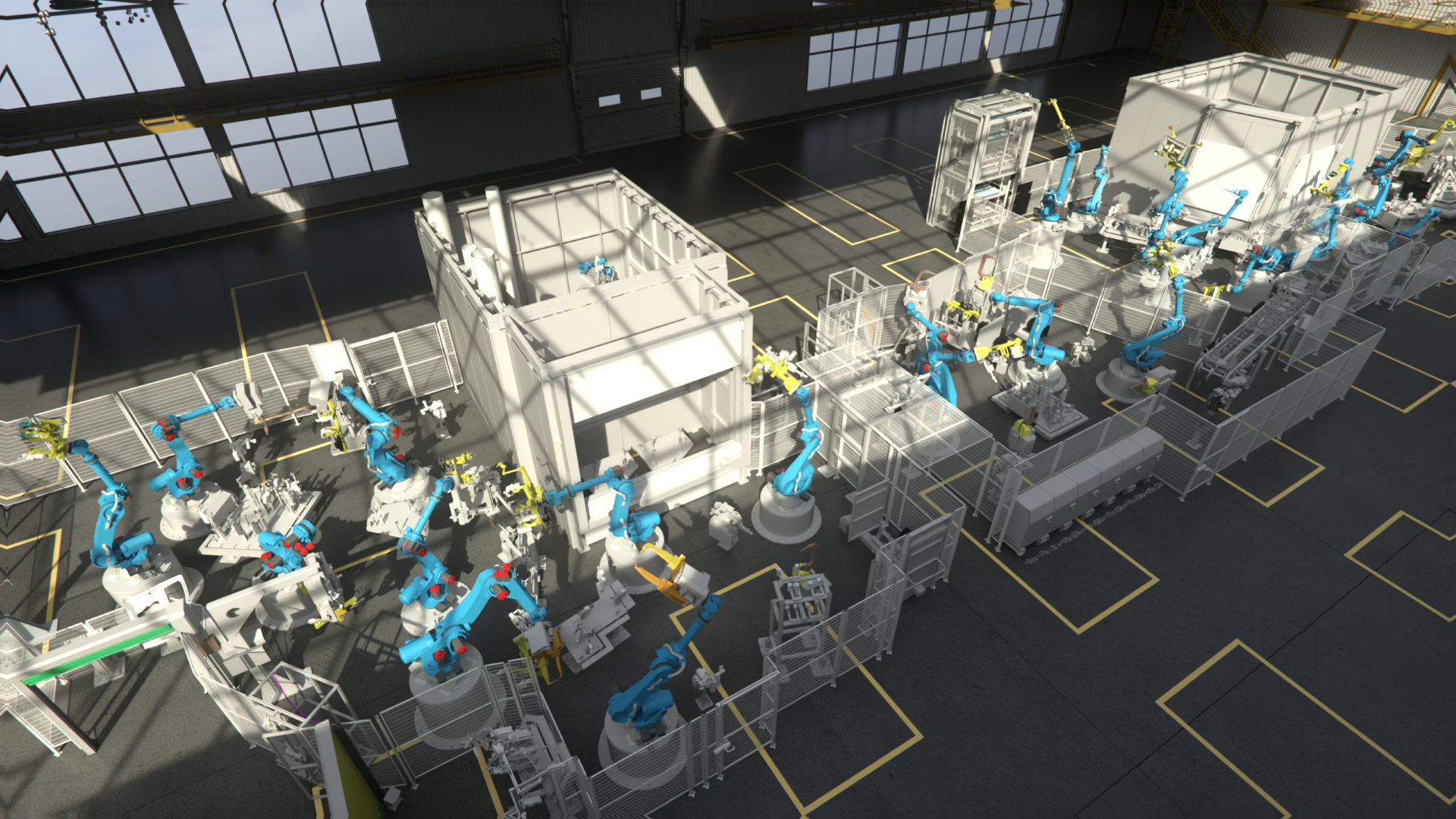
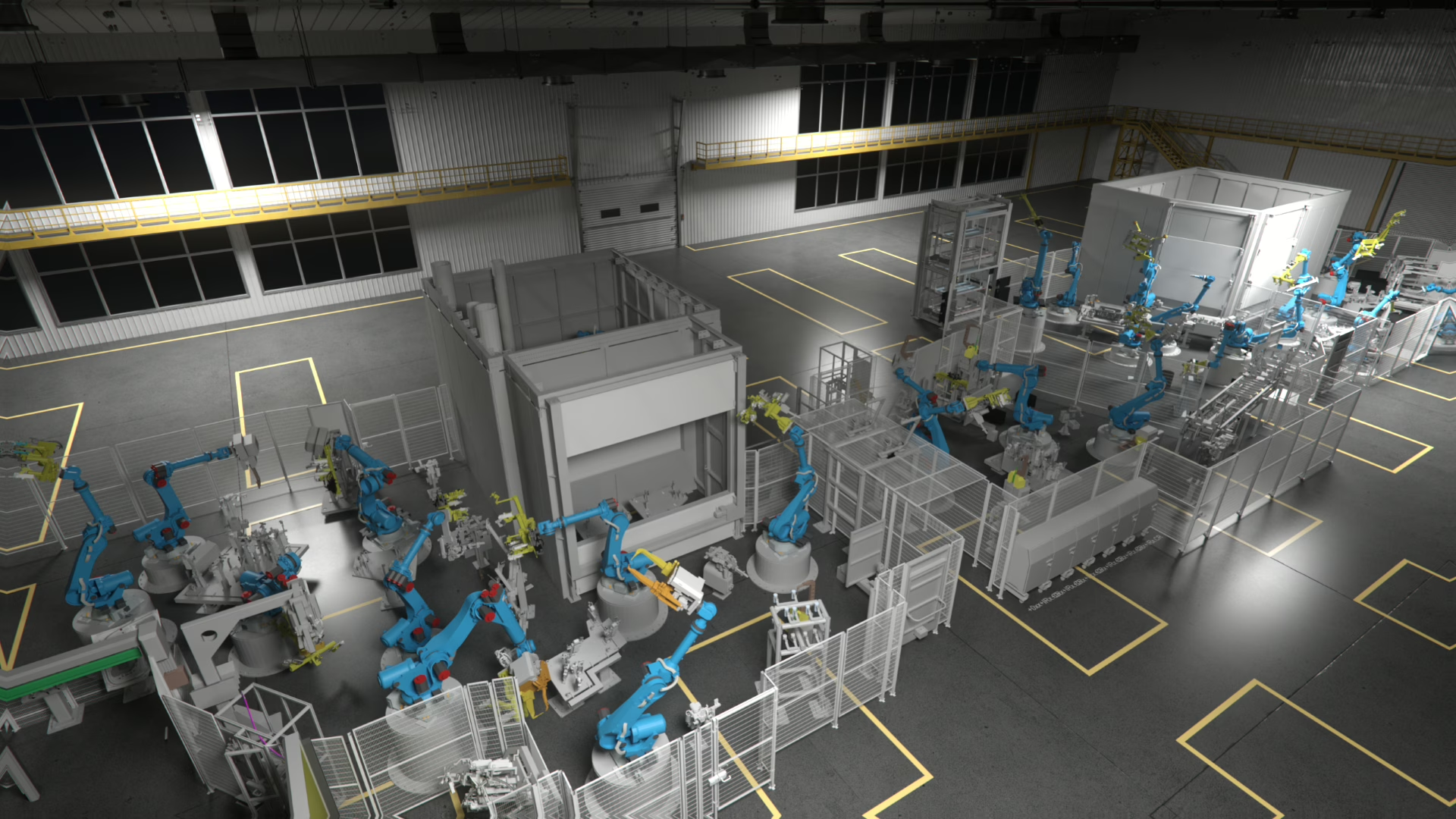
Switch between the physical production system and its virtual counterpart to see which RF::SUITE components reproduce the real automation layers.

System representation
01PLCControl software
02Robot ControlController and programs
03Electrical SystemSensors, actuators and I/O
04Mechanical SystemGeometry, motion and process
05WorkerHuman interaction

The real facility combines PLC software with robot control, electrical devices, mechanics and human interaction.

RF::SUITE for virtual commissioning

Specialized tools connected in one validation workflow.

The required setup depends on the plant, controller landscape and validation depth. RF::SUITE combines dedicated modules for model preparation, 3D behavior, peripheral simulation, robots, fieldbus communication and analysis.

3D simulation & material flow

RF::YAMS

Represents the production system in a dynamic 3D environment and simulates material movement, process states and system reactions.

Explore RF::YAMS
Virtual periphery

RF::ViPer

Models sensors, actuators and reusable device behavior so PLC logic and signal sequences can be tested realistically.

Explore RF::ViPer
Robot simulation

RF::RobSim

Connects robot behavior to the virtual system for program validation, movement checks and coordinated cell testing.

Explore RF::RobSim
Fieldbus simulation

RF::FSBox

Links real automation hardware with the virtual environment and simulates PROFINET and PROFIBUS devices for realistic signal exchange.

Explore RF::FSBox
Project preparation

RF::VPM Tool

Structures model and project preparation using engineering data, symbol lists, rule files and standardized signal information.

Explore RF::VPM Tool
Test evidence & analysis

RF::SCOUT

Supports detailed investigation of virtual commissioning results through process, cycle-time and interlock analysis.

Explore RF::SCOUT

Validation scope

Test the functions that determine whether the plant starts reliably.

Virtual commissioning is most effective when testing goes beyond a successful automatic cycle. EKS InTec structures the validation scope around normal operation, interfaces, disturbances and recovery behavior.

01

PLC logic and sequences

Automatic cycles, step chains, conditions, state transitions and synchronization across machines and stations.

02

I/O and signal mapping

Consistency of addresses, signal direction, device feedback, data exchange and interface definitions.

03

Operating modes and manual functions

Automatic, manual, setup and maintenance functions, including permissions and mode-dependent behavior.

04

Robot programs and interlocks

Robot-controller communication, release conditions, handshakes, path-related interactions and coordinated motion.

05

Faults, diagnostics and recovery

Sensor failures, missing parts, blocked sequences, diagnostic messages, acknowledgements and controlled restart procedures.

06

Material and process behavior

Part tracking, buffers, routing decisions, process states and the effect of timing relationships on the overall sequence.

07

HMI and operator interaction

Commands, status displays, messages and user workflows are checked against the behavior of the virtual equipment.

08

Acceptance and regression tests

Defined scenarios can be repeated after changes to confirm expected behavior and protect already validated functions.

The virtual plant in motion

See behavior, not just geometry.

A useful commissioning model does more than look like the real plant. It must reproduce the relevant reactions of equipment, material and process logic so the connected control software receives credible feedback.

RF::YAMS provides the dynamic 3D environment in which system states become visible and complete sequences can be understood by automation engineers, project teams and customers.

Flexible controller setup

Connect the configuration that fits your project.

Virtual commissioning can be built around real controller hardware, software-based controllers or a mixed environment. The decisive factor is a reliable exchange of signals and states between the automation software and the digital twin.

Hardware-in-the-loop

Real PLC

Use the actual controller hardware and automation program when hardware-specific communication, timing or system behavior is relevant to the validation target.

Software-in-the-loop

Soft PLC

Run control logic in a virtual controller environment to create a highly flexible setup for early tests, distributed teams and scalable test execution.

RF::SUITE Connect Tools

Reliable integration across automation platforms.

Dedicated interfaces connect common PLC environments, simulation systems and robot controllers to the RF::SUITE workflow.

RF::PSABridgePLCSim ConnectSiemensAllen-BradleyOmronABBKUKAFANUCYaskawa

How EKS InTec supports you

Start with a focused pilot or scale to a complete VIBN workflow.

The right entry point depends on internal expertise, project risk, available engineering data and the desired level of ownership. EKS InTec can provide targeted support or take responsibility for the complete virtual commissioning package.

01

Pilot project

Validate feasibility, interfaces and expected effort on a clearly bounded machine, cell or function before scaling the approach.

02

Complete project execution

From model preparation and controller connection to structured software tests, findings management and transfer to real commissioning.

03

Workflow integration

Establish roles, data requirements, model standards, test methods and release processes for repeatable use across projects.

04

Model and library development

Create reusable device behavior, project templates and simulation standards that reduce preparation effort over time.

05

Software and methodology training

Qualify automation engineers to build, connect and use RF::SUITE environments effectively in their own projects.

06

Project support and troubleshooting

Support teams with model behavior, communication interfaces, test strategy and technically demanding integration issues.

Where VIBN creates value

Built for complex automation and tightly connected production systems.

Robotics

Robot cells

Validate handshakes, motion-related interactions, peripheral devices and coordinated sequences before cell startup.

Manufacturing

Assembly lines

Test station logic, part tracking, line communication, operating modes and recovery across connected processes.

Machine building

Special-purpose machines

Verify complex control behavior and machine functions while mechanical and electrical implementation continues.

Expansion

Brownfield changes

Prepare software changes and new sequences in a virtual environment before intervention in an existing plant.

Material flow

Handling and intralogistics

Test routing, buffers, transfer logic and equipment coordination under variable material conditions.

Complex systems

Complete production sections

Connect several machines, controls and robot systems to validate cross-system dependencies and interfaces.

Value beyond startup

Keep the digital twin useful after commissioning.

The virtual model does not have to end when the real plant starts. When model quality, data ownership and update processes are considered early, the same environment can support later software changes, operator training and structured investigation.

This turns a project deliverable into a reusable digital asset that accompanies the production system through further lifecycle stages.

01Virtual commissioning and software validation
02On-site commissioning and ramp-up support
03Testing of later software changes
04Virtual training and qualification
05Comparison with real production behavior
Thanks to virtual commissioning, we develop and test our automation software entirely offline, before we ever set foot on the customer’s site.

Customer story

From on-site debugging to an offline-first engineering workflow.

PROPOINT integrated advanced virtual commissioning into its automation workflow with EKS InTec and RF::SUITE. The case study shows how a virtual-first approach changes project preparation, software testing and the work performed at the customer site.

Continue exploring

Go deeper into the method, tools and skills.

Technical article

How does Virtual Commissioning work?

Follow the workflow from digital twin creation and control connection to I/O validation and complete scenario testing.

Read the article
Software platform

Explore RF::SUITE

See the complete platform for simulation, virtual commissioning, data analysis, training and industrial connectivity.

View all RF::SUITE tools
Qualification

Build internal VIBN expertise

Practical software training helps engineering teams create models, connect systems and use the workflow independently.

Explore software training

Frequently asked questions

Virtual commissioning, clearly explained.

What is virtual commissioning?
Virtual commissioning is the simulation-based validation of automation software before the physical production system is fully available. A digital twin is connected to real or virtual controllers so PLC logic, robot programs, I/O, devices and complete operating sequences can be tested.
How is virtual commissioning different from production simulation?
Production simulation primarily evaluates process concepts, movements, material flow and timing. Virtual commissioning connects the system model to automation software and validates how control logic and equipment behavior interact. The disciplines complement each other and often share model data.
Can VIBN use both a real PLC and a soft PLC?
Yes. Hardware-in-the-loop uses real controller hardware, while software-in-the-loop uses a virtual controller. The appropriate setup depends on the controller platform, validation objectives, project phase and required test depth. Mixed configurations are also possible.
Which functions can be tested virtually?
Typical test areas include PLC sequences, operating modes, manual functions, I/O mapping, robot handshakes, interlocks, HMI behavior, material tracking, diagnostic messages, fault reactions, acknowledgements and restart procedures.
When should a virtual commissioning project start?
Test objectives and data requirements should be defined early in engineering. Model implementation can progress as geometry, signal lists, device information, process descriptions and software versions become available. Early coordination prevents avoidable conversion work later.
Does virtual commissioning replace real commissioning?
No. Physical commissioning remains necessary for real hardware, installation quality, final safety validation and site-specific conditions. VIBN moves a large share of software and integration testing into the virtual phase so on-site work can focus on the physical system.
What data is needed to build the digital twin?
The exact input depends on the system, but commonly includes 3D geometry, layouts, kinematics, signal lists, device specifications, robot data, process descriptions, operating concepts and PLC or robot software. EKS InTec defines the required information at project start.
Can the model be reused after commissioning?
Yes. With suitable model governance and update processes, the environment can support later software changes, regression tests, training and comparisons with real production behavior. Reuse requirements should be considered when the model architecture is defined.

Your next VIBN project

Validate more before the real commissioning window begins.

Whether you want to assess a pilot, execute a complete project or establish a repeatable virtual commissioning workflow, our team can help define the right technical and organizational starting point.

EKS Hub signup

We look forward to activating you for our customer portal. Please fill the fields bellow, we will notify you once access has been granted

Data protection information Your request is encrypted and transmitted to our server via HTTPS. You agree that we may use the information you provide to respond to your request. Further information can be found in our data protection declaration .